International · est. 2030
Europa Clipper and the Case for Oceans Under Ice
Jupiter's moon Europa probably holds more liquid water than every ocean on Earth combined, beneath a shell of ice. A spacecraft is on its way to find out how thick that shell is.
CivilisationInternational
RegionSpace
Period2030 CE to 2040 CE (estimated)
Published31 July 2026
Advertisement
Check the dates. Arrival and science timelines for outer solar system missions shift with trajectory planning and spacecraft health. Treat the years here as intent rather than schedule.
The habitable zone used to be defined by distance from a star: close enough for liquid water, far enough not to boil. By that definition Jupiter's moons are hopeless, sitting five times further from the Sun than Earth.
The definition was too narrow. A moon can be heated from the inside.
Why Europa Is Interesting
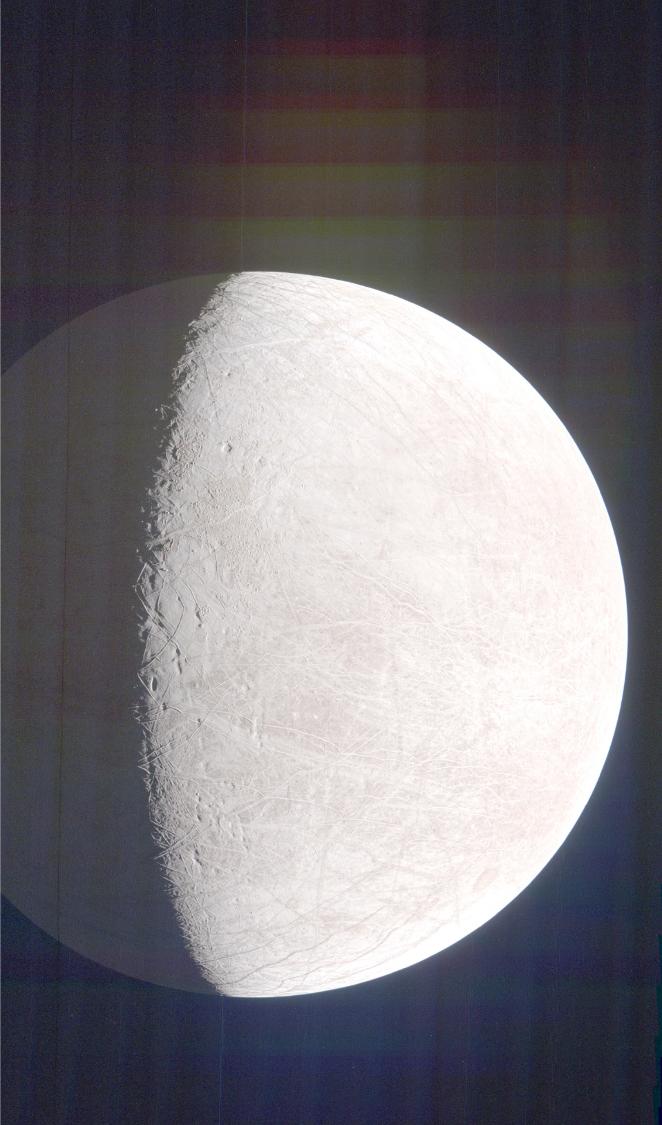
Europa is roughly the size of our own Moon and its surface is water ice. That surface is startlingly smooth and startlingly young, with very few impact craters, which means something resurfaces it on a timescale of tens of millions of years rather than billions.
The heat comes from tides. Europa's orbit is slightly eccentric and it is pulled by Jupiter and by the neighbouring moons Io and Ganymede. The flexing dissipates energy as heat inside the moon, and that heat is enough to keep a layer of liquid water beneath the ice.
The evidence for the ocean is indirect but strong. The Galileo spacecraft detected a magnetic signature consistent with a conducting layer under the surface, which a salty ocean would produce. Surface features look like ice that has cracked, drifted and refrozen.
The estimated volume is larger than all of Earth's oceans together.
Why That Might Matter for Life
Life as we understand it needs liquid water, an energy source, and the right chemical elements.
The water is there. The chemistry is plausible: Europa's rocky interior is in contact with the ocean, and if hydrothermal activity occurs at that boundary, it would resemble the vents on Earth's ocean floor where entire ecosystems live without sunlight.
The energy is the open question. Deep sea vent ecosystems on Earth run on chemistry rather than photosynthesis, so darkness is not disqualifying. Whether Europa produces enough chemical energy, and whether oxidants formed by radiation at the surface reach the ocean below, is exactly what a mission needs to measure.
What the Mission Does
Europa Clipper does not orbit Europa. It orbits Jupiter and makes repeated close flybys, dozens of them. This is a radiation decision: Jupiter's magnetosphere is savage, and a spacecraft parked at Europa would accumulate a lethal dose quickly. Looping out between passes lets the electronics recover.
Its instruments are aimed at the ice shell. Radar to sound through it and measure its thickness. Magnetometry to characterise the ocean's depth and salinity. Cameras and spectrometers to map composition and look for recently erupted material. A dust analyser to sample particles thrown off the surface.
If plumes exist, and there is contested evidence that Europa vents water into space, flying through one would let the spacecraft sample the ocean without landing.
What It Will Not Do
It will not detect life. It carries no instrument capable of that claim, and it is deliberately not designed to land or to touch the surface, partly to avoid contaminating a possible biosphere with terrestrial microbes.
The mission is a survey. It is meant to establish whether the ocean is reachable, where the ice is thinnest, and what the chemistry looks like, so that a later mission has somewhere specific to go.
Europa is not alone. Saturn's Enceladus vents water into space through cracks at its south pole, and Cassini flew through those plumes and found organic molecules. Ganymede, Callisto and Titan may all hold subsurface water. If oceans under ice are common, then the number of places where life could exist is far larger than the old habitable zone allowed.
Advertisement
Timeline Placement
2030 CE – 2040 CE
Near Future Era · International · Space
ScienceExplorationTechnology
Continue: International: A Complete Journey
Related Articles
Near FutureMission
Artemis: The Plan to Return to the Moon
NASA's programme to put crews back on the lunar surface, this time near the south pole and this time to stay. Dates ar…
3 min
Near FutureMission
Mars Sample Return: The Hardest Delivery Ever Attempted
Rock cores are already sealed and waiting in Jezero Crater. Getting them to a laboratory on Earth requires a launch fr…
3 min

Near FutureMission
Planetary Defence: We Have Now Moved an Asteroid
In 2022 a spacecraft hit a small asteroid hard enough to change its orbit. It was a test, it worked better than predic…
3 min
Recommended Reading
Space AgeOverview
Apollo: How Twelve People Walked on the Moon
The programme that took human beings to another world in under a decade, what it actually required, and why nobody wen…
4 min
📡
ContemporaryBriefing
Ancient DNA Is Rewriting Prehistory Faster Than Textbooks Can Follow
Genomes recovered from bone are settling arguments archaeology could not settle, and starting several new ones. An ong…
3 min
Further Reading
As an affiliate, we earn from qualifying purchases. These recommendations are independently selected.
Advertisement